Did you know that Truthout is a nonprofit and independently funded by readers like you? If you value what we do, please support our work with a donation.
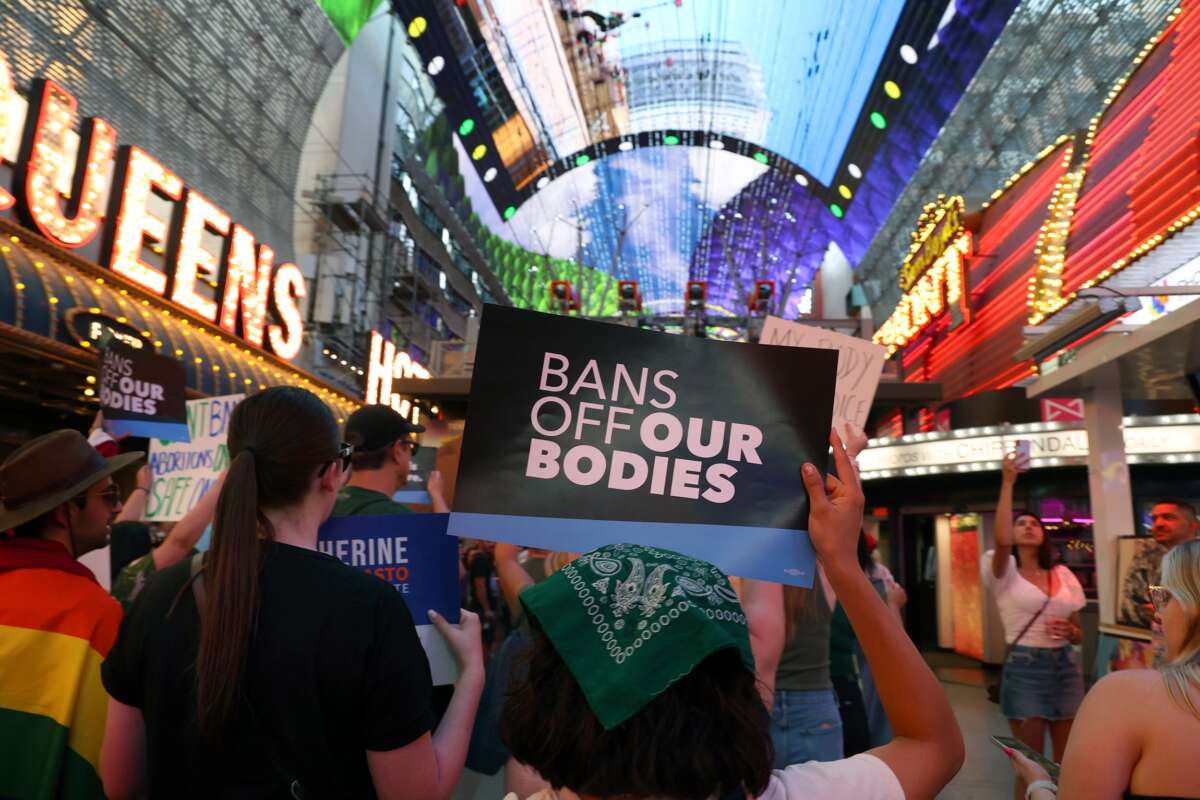
A petition drive in Nevada to place a constitutional abortion rights initiative on the 2024 November ballot can move forward, the State Supreme Court ruled last week.
The decision overturns a lower court’s ruling that had errantly said the wording in the petition had too many provisions within it.
The petition drive, which was still allowed to gather signatures pending the appeals process, is being organized by Nevadans for Reproductive Freedom (NRF). As of this week, the organization says it has collected more than 160,000 names in support of placing the amendment on the ballot.
Abortion is already protected in Nevada due to a state ballot initiative that passed decades ago. However, those protections only hold the weight of a state statute, and a constitutional amendment would ensure stronger, more lasting protections.
The proposed amendment would establish a “fundamental right” to abortion “until fetal viability” — generally regarded as being around 22-25 weeks of pregnancy — “or when needed to protect the life or health of the pregnant patient, without interference from the state or its political subdivisions.”
To get on this year’s ballot, a signature drive must attain 102,326 valid signatures by June 26, with at least 25,591 signatures emanating from each of the state’s four congressional districts. State rules on ballot initiatives have additional requirements pertaining to the content of a proposal, including the forbidding of “logrolling,” or including too many different, unrelated provisions within the same amendment.
An anti-abortion group in the state called Coalition for Parents and Children sued to have the proposal blocked, citing the logrolling rule. A lower court had ruled in favor of their complaints, which also included challenging the amendment’s clarity and lack of a funding component, which isn’t required in every type of ballot proposal.
On Thursday, the State Supreme Court said it disagreed with those arguments, and said the initiative could move forward and be included on the November ballot, if enough valid signatures were submitted by June.
“The initiative petition here has the single subject of establishing a fundamental right to reproductive freedom,” the state’s high court said in its opinion. “All the initiative’s provisions functionally relate and are germane to that subject and each other.”
Several reproductive rights organizations lauded the ruling from the State Supreme Court.
“Today’s decision is a resounding victory for our movement that builds on our momentum as we fight to lock the right to reproductive freedom into our state constitution,” said Denise Lopez, director of Reproductive Freedom for All Nevada. “As anti-abortion extremists continue to attack our fundamental rights — from abortion to birth control to fertility treatments — this decision recognizes that reproductive freedom includes all reproductive health care.”
Lindsey Harmon, president of Nevada for Reproductive Freedom, also said that the ruling is “an unequivocal recognition of what we’ve always known to be true: The right to reproductive freedom includes all aspects of a person’s reproductive care.”
Harmon also said her organization would be dedicated to protecting other reproductive rights in the future.
“While we have decided to pursue a petition focused on protecting abortion rights specifically, we will continue to pursue every possible avenue to make sure that all vital reproductive health services are protected in our state’s laws,” Harmon said.
Important Message: Please Read
For 25 years, Truthout has survived by publishing impactful investigative journalism and analysis; distributing full editions 365 days a year; and building a community of readers who support us with small, hard-earned donations.
Eighty percent of our $3 million yearly budget comes from small donors alone. Of those, 8,000 readers support us with monthly donations. Back in 2018, when Facebook decided to suppress the circulation of posts made by organizations, thereby cutting readers off from seeing many articles shared by the news organizations they had intentionally decided to follow, Truthout’s total traffic declined by 40 percent, as nearly all of our traffic from that platform disappeared.
Now, Google has recently rolled out its AI search bar, providing AI summaries instead of directing readers to our site. Google Search is our single largest source of traffic; it’s the route by which nearly one third of our readers find us. Much like in 2018, a shocking 40 percent of our Google traffic has disappeared overnight.
It will not be easy for Truthout to shoulder this blow. Nor will it be easy for our peers and collaborators — news sites that depend on traffic and aren’t bankrolled by large corporations.
If you can support Truthout with a donation today, you can help us resist the AI onslaught. Please give today.