Honest, paywall-free news is rare. Please support our boldly independent journalism with a donation of any size.
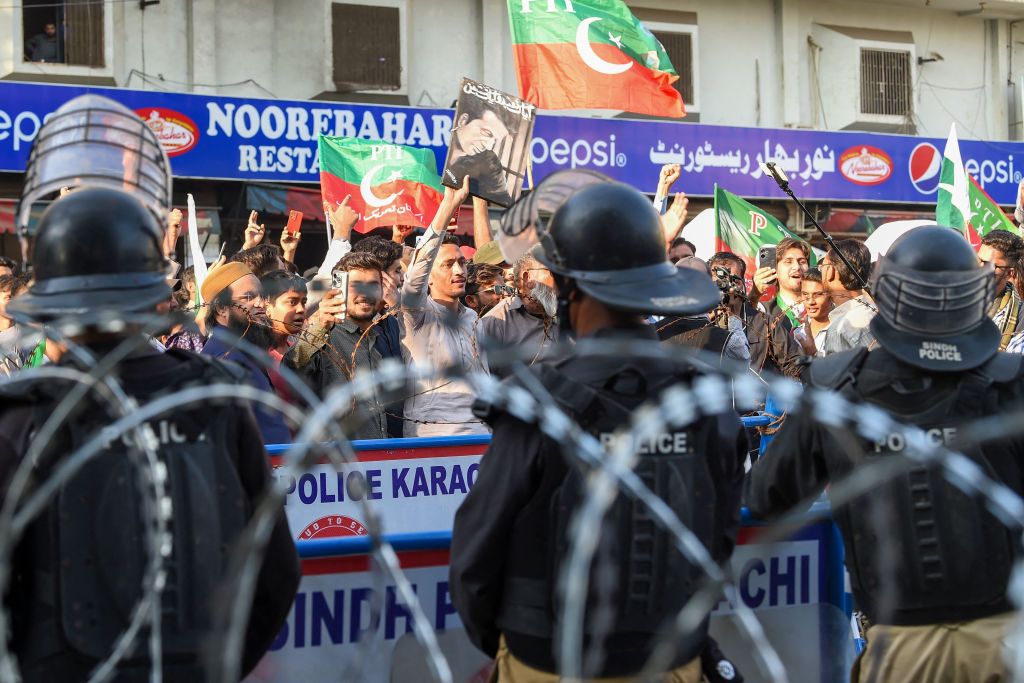
In what many observers called a “shock” result, candidates affiliated with imprisoned former Pakistani Prime Minister Imran Khan’s party won the most National Assembly seats in a general election that raised international concerns over alleged fraud committed by the country’s powerful military.
The Election Commission of Pakistan (ECP) said Saturday afternoon that independent candidates — 93 of them affiliated with Khan’s Pakistan Tehreek-e-Insaf (PTI) party — won 100 of 265 contested parliamentary seats. The conservative Pakistan Muslim League Nawaz party, led by former Prime Minister Nawaz Sharif, won 73 seats. Most pollsters had expected the party to win the most seats. The center-left Pakistan People’s Party was in third place with 54 seats. Nearly two days after polls closed, results were still not in for 10 seats.
Both Khan and Sharif declared victory Friday, but with none of the three major parties winning the 169 seats required for a parliamentary majority, it remains unclear who will be chosen to lead the nuclear-armed nation of 245 million inhabitants.
As The New York Times‘ Christina Goldbaum reported from Islamabad:
The success of Mr. Khan’s party was a head-spinning upset in an election that the military thought would be an easy victory for Mr. Sharif. Ahead of last week’s election, Pakistan’s powerful generals had jailed Mr. Khan, arrested candidates allied with him and intimidated his supporters to clear his party from the playing field — or so they thought. Instead, the election results confirmed that Mr. Khan remains a formidable force in Pakistani politics, despite his ouster and subsequent imprisonment…
Mr. Khan, a former cricket star turned populist politician, was sentenced to a total of 34 years in prison after being convicted in four separate cases on charges that included leaking state secrets and unlawful marriage, and that he has called politically motivated.
PTI leaders sounded the alarm on what they said was the military’s widespread rigging of at least dozens of races.
The Free and Fair Election Network (FAFEN), a Pakistani civil society coalition, said approximately 60 million Pakistanis voted in the elections and that more than 1.1 million election officials performed their duties well despite the “highly challenging political environment.”
“They ensured the integrity of voting and counting processes at the polling stations that largely remained free of controversy… against the backdrop of fears of militant and political violence,” FAFEN added.
However, FAFEN lamented “the caretaker government’s suspension of cellular and internet services on election day — regardless of the security reasons — undermined years of parliamentary efforts to reform the election results management process through amendments to the Elections Act, 2017, which were meant to maximize the integrity, efficiency, and transparency of electoral outcomes.”
The government was also widely criticized for imposing a telecommunications blackout that blocked cell phone and internet service across the country during the election. Government officials said the blackout was necessary for national security reasons after Wednesday’s bombings in Balochistan that killed and wounded scores of people. However, critics noted the nationwide nature of the telecom suspension in refuting the government’s “security” claims.
In the United States — whose government stands accused of helping to oust Khan — State Department spokesperson Matthew Miller on Friday expressed concerns over “undue restrictions on freedoms of expression, association, and peaceful assembly” during the election.
“We condemn electoral violence, restrictions on the exercise of human rights and fundamental freedoms, including attacks on media workers, and restrictions on access to the Internet and telecommunication services, and are concerned about allegations of interference in the electoral process,” Miller added. “Claims of interference or fraud should be fully investigated.”
Press freedom is under attack
As Trump cracks down on political speech, independent media is increasingly necessary.
Truthout produces reporting you won’t see in the mainstream: journalism from the frontlines of global conflict, interviews with grassroots movement leaders, high-quality legal analysis and more.
Our work is possible thanks to reader support. Help Truthout catalyze change and social justice — make a tax-deductible monthly or one-time donation today.