Did you know that Truthout is a nonprofit and independently funded by readers like you? If you value what we do, please support our work with a donation.
The last several months of the Trump administration’s reign have seen the deployment of language restriction as a tactic in the systemic erosion of civil rights. While the scale has intensified dramatically, this enforcement of social hegemony through literary and aesthetic regulation is not a new phenomenon. Historian Andrew Hartman contends that “the history of America, for better and worse, is largely a history of debates about the idea of America.” We are watching this ideological question play out violently, attempting to delineate which bodies are “American,” what behavior is “American,” and what art, what literature, what television is “American.” One of the many ways this debate is performed is through grand displays of moral outrage over literature, as well as through the banning of books and education material.
In the 2023-2024 academic year, schools and libraries across the country fought a record number of book bans — a figure that will likely rise as increasing restrictions are imposed on academic institutions, museums, and libraries. In late 2023, California Gov. Gavin Newsom signed an assembly bill into law protecting school curricula from gender- and race-based bans. Tony Thurmond, state superintendent of public instruction, celebrated this victory, proclaiming that the measure “sends a strong signal to the people of California — but also to every American — that in the Golden State — we don’t ban books — we cherish them.”
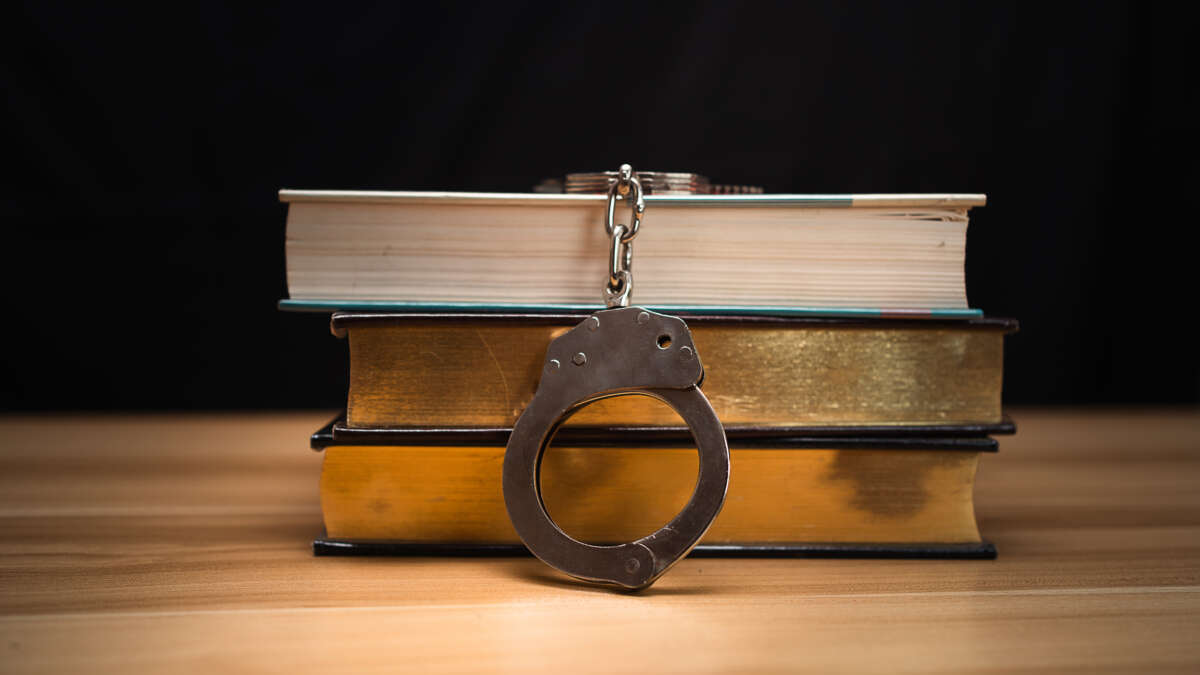
While these safeguards are undeniably important, Thurmond’s conviction that “we don’t ban books” is missing a caveat: We don’t ban books here — except in our state prisons. Access to literature for people experiencing incarceration has always been heavily monitored; often the very same books that state officials fight for access to in public schools are restricted in jails and prisons.
Chuck Murdoch, 68, has experienced this firsthand. On August 19, 2024, his memoir Badfish: Stories from the Dark House was published by Blue Ear Books.
The book is a product of nearly three decades worth of Murdoch’s writings, a chronicle of his past 30 years spent languishing across various California state prisons, despite abundant evidence pointing toward his innocence. He explains the title in the introduction: “Badfish” is the moniker Murdoch bestowed upon himself, inspired by the band Sublime’s 1997 hit of the same name. “DARK HOUSE” is used throughout the book as a surrogate word for prison.
Murdoch’s conviction derived from a 1983 robbery-murder in a bar in Long Beach, California — a case that went cold for 11 years, until a jailhouse informant offered Murdoch’s name during questioning. He was sentenced to life without the possibility of parole, despite large doubts remaining about his culpability. (He had not matched the description of initial reports, nor was he selected by any eyewitnesses in photo lineups conducted in the days after.) Further doubts emerged in post-conviction appeals: A senior Eighth Circuit judge decried the suppression of a note revealing that the informant had received a lesser sentence in exchange for a confession implicating Murdoch. Years later, another judge dissented the denial of federal relief, deeming the conviction a “truly spectacular miscarriage of justice.”
Despite these acknowledgements, Murdoch is still living out his sentence at the High Desert State Prison in Susanville, California, 30 years later. Having never been able to truly meet his children due to his incarceration, Murdoch wrote the book primarily for them to know their father. Over the course of three chronological sections, the book follows Murdoch’s early life, his early passage through the jail system after his brief stint as the “Baskin-Robbins Bandit,” and the 30 years of prison time that followed his wrongful conviction. He documents the reality of life inside prison — the violence, abuse, and manipulation of truth. The book is a personal account of the sheer suffering perpetuated by the U.S. carceral system.
The day Badfish wasreleased in August 2024, Murdoch’s sister sent him a copy. Weeks passed, and he did not receive it. In September, Blue Ear Books received a letter from the California Department of Corrections and Rehabilitation’s Division of Adult Institutions informing them that Badfish had been confiscated as contraband and placed on the centralized list of banned publications across California prisons. This decision, the letter said, was based on the belief that the work presented“a serious threat to facility security or the safety of incarcerated people and staff.” The letter did not specify which element of the book was so threatening, nor did the prison respond to sustained requests to clarify or review this ban.
“I have not ever seen my published book. I’ve never held it.”
Murdoch confirmed over the phone that one year after the publication of his life story, he has still never seen his completed work. “I have not ever seen my published book. I’ve never held it,” he told Truthout. “I talk about the prison system, how a lot of things are unfair, and kind of unreasonable, irrational. And for some reason, the California Department of Corrections decided to ban my book and disallow it. So they’re not allowing it into prisons for any prisoners to read, not even myself.”
Recently, the California Department of Corrections and Rehabilitation was required to publicly list its Disapproved Publications, displaying the hundreds of titles that have been deemed a threat to security. There is no specific requirement for qualities that merit suppression, just that they present a “legitimate penological interest.” Basic Drawing by Louis Priscilla rests atop the “B” section — the list informs us that it “contains frontal nudity.” Considering nudity in art potentially dangerous seems ironic when the group “at risk” has nearly nonexistent privacy. Would a glimpse of Michelangelo’s David present a security risk to those who are forced to shower with strangers? Further down, we are told that Margaret Atwood’s The Handmaid’s Tale is disallowed for lacking “serious literary, artistic, political or scientific value.” This murky phrasing does not reveal what qualities merit “serious value” in the eyes of the California Department of Corrections and Rehabilitation. Further still, The Kite Runner allegedly“contains conduct which is or appears to be forceful, threatening or violent,” and Merriam-Webster’s Visual Dictionary “presents a serious threat to facility security.”
As we fight the increasing suppression of material in our schools, libraries, and historical records, we must not forget the people living through incarceration.
These nonsensical justifications seem to be at odds with the newly minted “California Model” currently being implemented at San Quentin, inspired by the “Nordic Model” of imprisonment guided by rehabilitation. The California Department of Corrections and Rehabilitation website claims that the model aims to expand education and job opportunities, reentry planning, and shift expectations for correctional officers to implement a more rehabilitative environment. However, the arbitrary limitation of reading material clashes with this vision.
Book bans are recognized by California officials at the public school curriculum level to be damaging and controlling. Why does this recognition not extend to populations beyond students? The vast majority of those behind bars will leave at some point — should we not ensure that those re-entering society are better educated, better informed? Murdoch himself reiterated this discrepancy. “I think that my book, getting my book published, is a testament to rehabilitation — I had to teach myself how to read and write … I would have hoped the Department of Corrections would have stood behind me and supported me in that, but instead they banned my book,” he said.
After one year of waiting and a lifetime plundered from him, Murdoch is still being denied the only thing he can call his own: his life story, his personal truth. Despite this suppression being a more subtle cruelty in the larger scale of incarceration, repressive control of information and abuse of power is destructive on any level. The State of California acknowledges that the diversity of representation and artistic form in the public arena is essential, and yet, censorship practices are utilized openly against some of the state’s most vulnerable citizens. The strict regulation of art, news, and literature under the guise of “safety” or “value” or “obscenity” are smokescreens that have been employed to retain control over the voices and subject matter available to readers or viewers. As we fight the increasing suppression of material in our schools, libraries, and historical records, we must not forget the people living through incarceration — those who are all too familiar with navigating this erasure, arbitrary restriction, and state-sanctioned censorship.
Media that fights fascism
Truthout is funded almost entirely by readers — that’s why we can speak truth to power and cut against the mainstream narrative. But independent journalists at Truthout face mounting political repression under Trump.
We rely on your support to survive McCarthyist censorship. Please make a tax-deductible one-time or monthly donation.