Truthout is an indispensable resource for activists, movement leaders and workers everywhere. Please make this work possible with a quick donation.
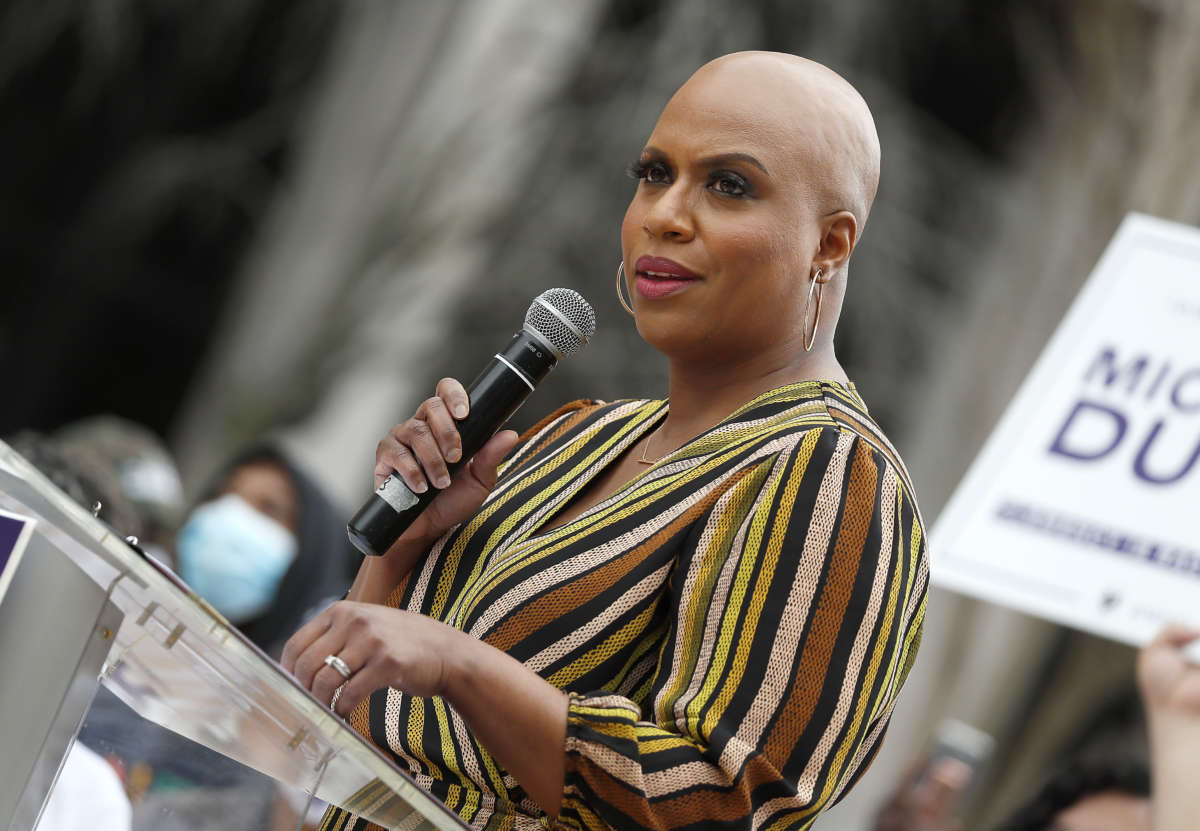
Representatives led by Rep. Ayanna Pressley (D-Massachusetts) are urging party leaders to include additional funding for public transportation on top of the “wholly inadequate” investment allotted in the bipartisan infrastructure bill.
In the letter, Pressley and Democratic colleagues, including 61 cosigners, urge Democratic leaders to add $30 billion for public transportation to the $3.5 trillion bill. This would be in addition to the $39 billion from the bipartisan infrastructure bill that the lawmakers point out is $71 billion less than President Joe Biden’s original proposal.
The amount allocated in the infrastructure bill is “wholly inadequate to meet current needs,” the lawmakers write. “The urgency of the climate crisis and the need for a robust economic recovery demand more.”
Now is the time to make such an investment, the lawmakers argue. The reconciliation bill, which is also known as the “Build Back Better” bill, is a “once in a generation opportunity to build a sustainable and prosperous future for our country,” the lawmakers write.
The letter sent Thursday is addressed to Democratic leadership and House Committee Transportation & Infrastructure Chair Peter DeFazio (D-Oregon) and Senate Committee on Banking, Housing, and Urban Affairs Chair Sherrod Brown (D-Ohio), and is led by Representatives Pressley, Jesús G. “Chuy” Garcia (D-Illinois) and Henry C. “Hank” Johnson Jr.
Pointing out recent climate disasters like this summer’s heat waves and Tropical Storm Ida, which exposed gaping weaknesses in New York City’s public transit infrastructure, the Democrats say that the climate crisis heightens the need for public transportation investments.
“While we support additional funding for electric vehicles, studies are clear that electric vehicles alone will not allow the United States to meet its climate goals in transportation. We must expand the use of other modes of transportation, especially public transit,” they write.
“A significant expansion of public transit in both urban and rural areas is needed, especially in fast-growing areas like the Southeastern United States, and this goal can only be achieved through additional robust funding provided through the reconciliation legislation,” the Democrats continue.
Indeed, climate researchers say that simply replacing gas cars with electric cars won’t decarbonize to the extent that’s necessary to significantly mitigate the climate crisis. Transportation is responsible for the largest share of greenhouse gas emissions in the U.S.
It’s resource intensive to manufacture and ship electric vehicles, especially the batteries. With the current pace of research and development on electric vehicles, experts say it may be many years before they’re as sustainable to manufacture in terms of emissions.
Massive investment in public transportation will be necessary to make the option more enticing than cars. Green New Deal proponents say that an eventual massive climate bill or a Green New Deal specifically for public transportation could not only help draw down emissions, but also help with equity issues around transportation.
“Safe, affordable and reliable public transportation is a public good and should be invested in as such,” Pressley said in a statement. “[P]olicymakers have a moral responsibility to prioritize robust investments that will help make our public transit systems more accessible and sustainable for generations to come.”
Press freedom is under attack
As Trump cracks down on political speech, independent media is increasingly necessary.
Truthout produces reporting you won’t see in the mainstream: journalism from the frontlines of global conflict, interviews with grassroots movement leaders, high-quality legal analysis and more.
Our work is possible thanks to reader support. Help Truthout catalyze change and social justice — make a tax-deductible monthly or one-time donation today.