Part of the Series
Moyers and Company
Honest, paywall-free news is rare. Please support our boldly independent journalism with a donation of any size.
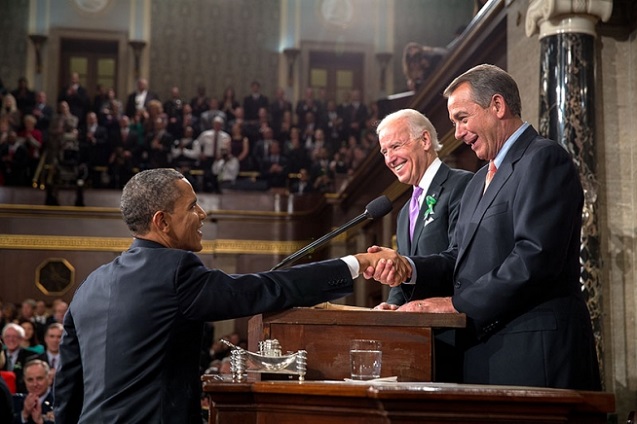
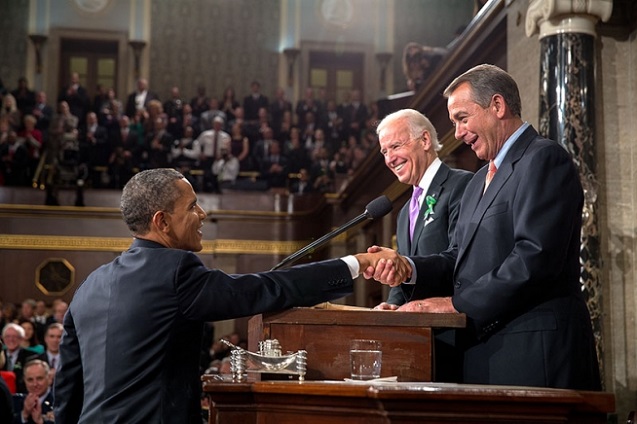 President Barack Obama greets Vice President Joe Biden and House Speaker John Boehner before delivering the State of the Union address in the House Chamber at the US Capitol in Washington, DC, February 12, 2013. (Official White House Photo by Pete Souza)
There are two sides to the story of special interest money in Washington, according to an op-ed today in The New York Times by Peter Schweizer, a fellow at the conservative Hoover Institution. While the traditional narrative is that politicians are corrupted by wealthy interests, Schweizer says we may be getting it wrong.
He says some politicians are involved in a type of “legal extortion” to get their hands on cash, with terms like the “tollbooth” and “milker bills” describing some of these practices. Whatever you call it, it doesn’t sound like the type of democracy we’d ideally like to have. He writes:
Consider this: of the thousands of bills introduced in Congress each year, only roughly 5 percent become law. Why do legislators bother proposing so many bills? What if many of those bills are written not to be passed but to pressure people into forking over cash?
This is exactly what is happening. Politicians have developed a dizzying array of legislative tactics to bring in money.
Take the maneuver known inside the Beltway as the “tollbooth.” Here the speaker of the House or a powerful committee chairperson will create a procedural obstruction or postponement on the eve of an important vote. Campaign contributions are then implicitly solicited. If the tribute offered by those in favor of the bill’s passage is too small (or if the money from opponents is sufficiently high), the bill is delayed and does not proceed down the legislative highway.
House Speaker John A. Boehner appears to be a master of the tollbooth. In 2011, he collected a total of over $200,000 in donations from executives and companies in the days before holding votes on just three bills. He delayed scheduling a vote for months on the widely supported Wireless Tax Fairness Act, and after he finally announced a vote, 37 checks from wireless-industry executives totaling nearly $40,000 rolled in. He also delayed votes on the Access to Capital for Job Creators Act and the Small Company Capital Formation Act, scoring $91,000 from investment banks and private equity firms, $32,450 from bank holding companies and $46,500 from self-described investors — all in the 48 hours between scheduling the vote and the vote’s actually being held on the House floor.
Another tactic that politicians use is something beltway insiders call “milker bills.” These are bills designed to “milk” donations from threatened individuals or businesses. The real trick is to pit two industries against each other and pump both for donations, thereby creating a “double milker” bill.
President Obama and Vice President Joseph R. Biden Jr. seemed to score big in 2011 using the milker tactic in connection with two bills: the Stop Online Piracy Act and the Preventing Real Online Threats to Economic Creativity and Theft of Intellectual Property Act. By pitting their supporters in Silicon Valley who opposed the bills against their allies in Hollywood who supported the measures, Mr. Obama and Mr. Biden were able to create a sort of fundraising arms race.
Media that fights fascism
Truthout is funded almost entirely by readers — that’s why we can speak truth to power and cut against the mainstream narrative. But independent journalists at Truthout face mounting political repression under Trump.
We rely on your support to survive McCarthyist censorship. Please make a tax-deductible one-time or monthly donation.