Truthout is a vital news source and a living history of political struggle. If you think our work is valuable, support us with a donation of any size.
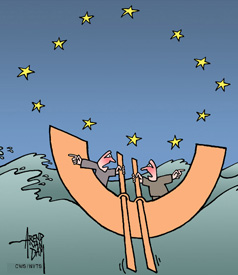
This is the way the euro ends. Not with a whimper, but with a bank run.
OK, I’m overstating the case — we are still a long way from Ireland’s exiting the euro. But in thinking about the ongoing Irish mess, I realized we are drifting closer to the kind of scenario I wrote about earlier this year during the Greek debt crisis.
I used to be a full believer in the economist Barry Eichengreen’s theory of euro irreversibility: no European nation can even discuss leaving the euro because the anticipated devaluation will lead people to move deposits to other euro-zone banks, leading to the mother of all bank runs. But I’ve been reconsidering this stance, because while the Eichengreen argument explains why nations should not plan on leaving the euro, what if the bank runs and financial crisis happen anyway? In that case, the marginal cost of a nation’s leaving the euro falls dramatically, and in fact, the decision may effectively be taken out of policy makers’ hands.
On Nov. 17, the Financial Times reported that the Bank of Ireland admitted it has lost 10 billion euros in corporate deposits since September. Another bank, Irish Life & Permanent, reported an 11 percent drop in customer deposits in August and September. Hank Calenti, a credit analyst at Société Générale, a major European financial services firm, told the Financial Times: “You don’t see people queueing around the block, but it seems there’s a silent run on corporate deposits.”
What the Financial Times is describing is a sort of slow-motion run on Irish banks, with corporate depositors gradually reducing their accounts. It is not crisis-level yet. But the whispers of a possible ejection from the euro are starting to become more audible.
Let Truthout send our best stories to your inbox every day, for free.
One commenter recently suggested to me that Ireland isn’t facing a bank run — it’s facing a bank walk. At this point, actually, it’s more of a bank stroll or a bank saunter. We’ll see if the pace picks up.
Recently I came to a realization about the true nature of Ireland’s big mistake: It should have been Texas. Think about it. The United States’s savings-and-loan crisis of the 1980s and 1990s was about runaway banks. Loose regulations led to risky investments on the part of hundreds of savings and loan institutions, and then they had to be bailed out at (tremendous) taxpayer expense. And as best I can determine, about half the cost to taxpayers came from just one state — Texas. Yet the burden was borne nationally.
But, unlike Texas, Ireland bailed out its own banks in 2009. If the European Union had taken over responsibility for the runaway Irish banks that fueled the nation’s devastating housing bubble, the situation would be much less serious. The Irish just picked the wrong continent on which to engage in crony capitalism.
Backstory: Political Casualties
On Nov. 21, following months of investor speculation about the ability of Irish banks to honor their debts, Irish Finance Minister Brian Lenihan petitioned the International Monetary Fund, the European Central Bank and the European Commission for an infusion of cash to rescue the nation’s banking system.
European Union government officials, recognizing the need to avoid destabilization of the euro zone, had been pushing Ireland to accept a rescue package to aid its debt-ravaged banks. They agreed to the request the next day. The $114 billion loan package will allow Ireland to restructure its banking system and avoid having to borrow money at high rates, but it comes with strings attached. Conditions attached to the loan include steep tax increases and sharp cutbacks in Ireland’s social welfare programs and public spending.
While Ireland’s euro-zone neighbors welcomed news of the bailout, the story was different at home — the Irish have endured austerity measures for more than a year. Protesters broke into Prime Minister Brian Cowen’s office after the announcement of the bailout, and Moody’s Investors Service lowered the rating on Irish debt a few notches. The threat of political instability led Mr. Cowen to announce that he would dissolve the government after passage of the country’s 2011 budget in early December, and that he will call for new elections early next year.
The Irish government’s budget plan, to be put to a vote on Dec. 7, includes a four-year target to reduce the deficit from about 32 percent to 3 percent of gross domestic product by 2014. It would cut about 10 billion euros in public spending and introduce 5 billion euros in additional tax hikes. Also, the Irish government is expected to take over the two largest banks in the nation, Allied Irish Banks and the Bank of Ireland, after declines in their share prices followed news of the bailout.
© 2010 The New York Times Company
Truthout has licensed this content. It may not be reproduced by any other source and is not covered by our Creative Commons license.
Paul Krugman joined The New York Times in 1999 as a columnist on the Op-Ed page and continues as a professor of economics and international affairs at Princeton University. He was awarded the Nobel in economic science in 2008.
Mr Krugman is the author or editor of 20 books and more than 200 papers in professional journals and edited volumes, including “The Return of Depression Economics” (2008) and “The Conscience of a Liberal” (2007).
Copyright 2010 The New York Times.
Important Message: Please Read
For 25 years, Truthout has survived by publishing impactful investigative journalism and analysis; distributing full editions 365 days a year; and building a community of readers who support us with small, hard-earned donations.
Eighty percent of our $3 million yearly budget comes from small donors alone. Of those, 8,000 readers support us with monthly donations. Back in 2018, when Facebook decided to suppress the circulation of posts made by organizations, thereby cutting readers off from seeing many articles shared by the news organizations they had intentionally decided to follow, Truthout’s total traffic declined by 40 percent, as nearly all of our traffic from that platform disappeared.
Now, Google has recently rolled out its AI search bar, providing AI summaries instead of directing readers to our site. Google Search is our single largest source of traffic; it’s the route by which nearly one third of our readers find us. Much like in 2018, a shocking 40 percent of our Google traffic has disappeared overnight.
It will not be easy for Truthout to shoulder this blow. Nor will it be easy for our peers and collaborators — news sites that depend on traffic and aren’t bankrolled by large corporations.
If you can support Truthout with a donation today, you can help us resist the AI onslaught. Please give today.