Honest, paywall-free news is rare. Please support our boldly independent journalism with a donation of any size.
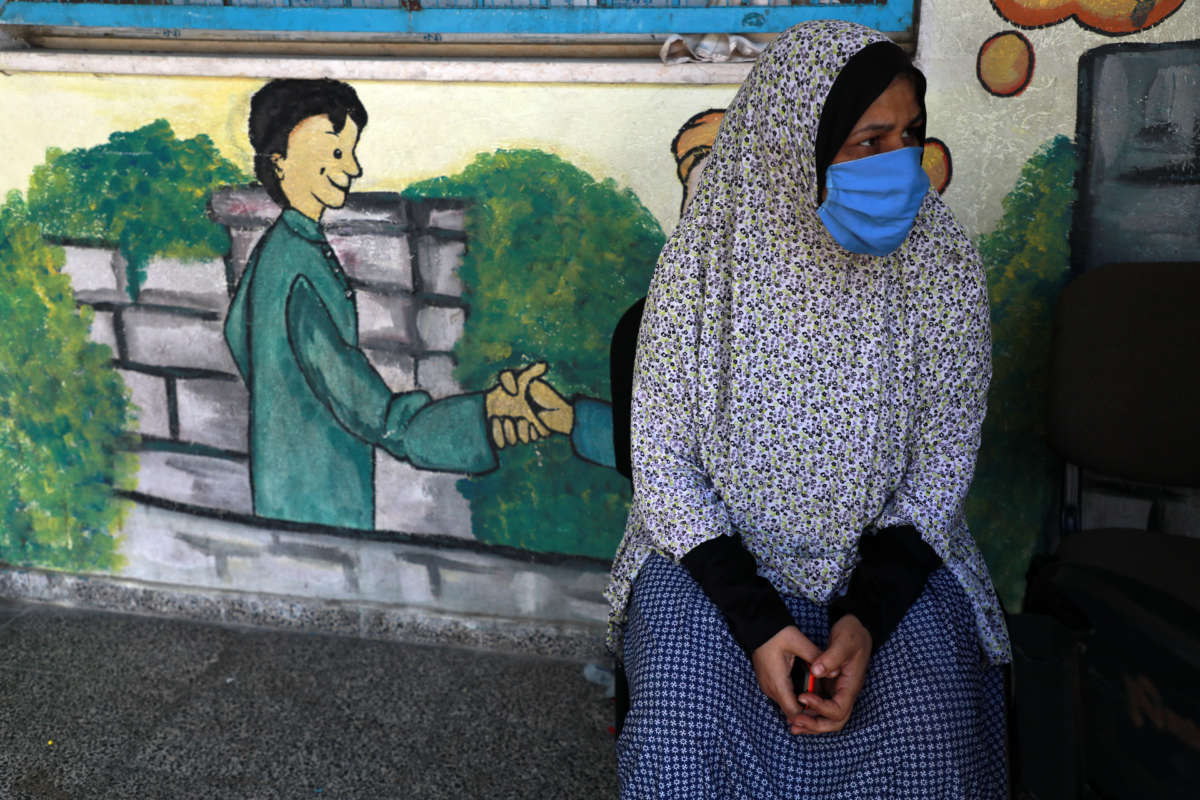
As healthcare workers in Gaza cope with the aftermath of the Israel Defense Forces’ 11-day bombardment campaign, health officials on Saturday expressed fear that the effects of thousands of Palestinians crowding into shelters for safety from the airstrikes was becoming apparent as coronavirus cases appeared to surge in the besieged territory.
More than 1,900 people were injured in the IDF attacks, with people of all ages crowding hospitals and forcing officials to evacuate Covid-19 patients from critical care wards to make room.
According to the Washington Post, about 70,000 people in Gaza sought refuge in schools, underground shelters, community centers, and other sites as residential areas were bombed and homes were destroyed. Thousands of people also crowded into relatives’ homes.
“People stopped [social] distancing,” Dr. Shadi Awad, head of respiratory care at al-Shifa hospital, told the Post. “They had no choice.”
As Common Dreams reported last week, Israel bombed Gaza’s only coronavirus testing facility and Dr. Ayman Abu al-Ouf, who helped lead the territory’s coronavirus response, was one of at least 248 Palestinians killed.
The loss of the testing lab will leave asymptomatic Covid-19 cases undetected, health officials told the Post, in a place where less than 2% of the population has been vaccinated — compared with more than 56% of Israelis.
On Friday, al-Shifa hospital was able to test 50 people and found that 40 tested positive for the coronavirus, leading to critical care beds being filled to capacity.
Palestinian-American writer and political analyst Yousef Munayyer tweeted last week that a public health “nightmare” would likely take hold in Gaza once the bombing stopped, as it did early Friday following a ceasefire.
So many health assets are under attack in Gaza, doctors have been killed, clinics damaged, roads to hospital bombed. All this comes as Palestinians there will have to cope with mass casualties on top of the covid pandemic Israel refused to give them vaccines for. Nightmare
— Yousef Munayyer (@YousefMunayyer) May 16, 2021
In addition to the crowding of hospitals and shelters where Covid-19 has apparently been able to spread rapidly, water supplies have been cut by 40% in Gaza, leading to sanitation concerns.
The United Nations Relief and Works Agency for Palestinian Refugees (UNRWA) on Friday called for $38 million in relief funding for food, water, health needs, and sanitation and hygiene.
“Despite the preparedness of UNRWA staff and UNRWA facilities in providing shelter in conflict, UNRWA now also contends with the unprecedented circumstance of the Covid-19 pandemic which requires additional measures to be taken,” said the agency.
The International Committee of the Red Cross told the Post it was sending medical supplies including monitors, defibrillators, and a mechanical ventilator to Gaza, while the COVAX vaccine program planned to deliver a shipment of coronavirus vaccine doses to the territory.
The Israeli blockade, however, will make it difficult for the equipment and doses to reach overwhelmed hospitals quickly.
UNRWA said the surge in Covid-19 cases will only worsen Gaza’s already limited ability to recover from the latest Israeli bombardment.
“Every time there is a conflict in Gaza, intense air bombardment pulverises basic infrastructure, homes, hospitals, and factories,” Tamara al-Rifai, a spokesperson for UNRWA, said in a statement. “It then takes UNRWA and aid agencies several years to rehabilitate their premises and many homes and livelihoods of Gazans are never rebuilt.”
Important Message: Please Read
For 25 years, Truthout has survived by publishing impactful investigative journalism and analysis; distributing full editions 365 days a year; and building a community of readers who support us with small, hard-earned donations.
Eighty percent of our $3 million yearly budget comes from small donors alone. Of those, 8,000 readers support us with monthly donations. Back in 2018, when Facebook decided to suppress the circulation of posts made by organizations, thereby cutting readers off from seeing many articles shared by the news organizations they had intentionally decided to follow, Truthout’s total traffic declined by 40 percent, as nearly all of our traffic from that platform disappeared.
Now, Google has recently rolled out its AI search bar, providing AI summaries instead of directing readers to our site. Google Search is our single largest source of traffic; it’s the route by which nearly one third of our readers find us. Much like in 2018, a shocking 40 percent of our Google traffic has disappeared overnight.
It will not be easy for Truthout to shoulder this blow. Nor will it be easy for our peers and collaborators — news sites that depend on traffic and aren’t bankrolled by large corporations.
If you can support Truthout with a donation today, you can help us resist the AI onslaught. Please give today.