Truthout is a vital news source and a living history of political struggle. If you think our work is valuable, support us with a donation of any size.
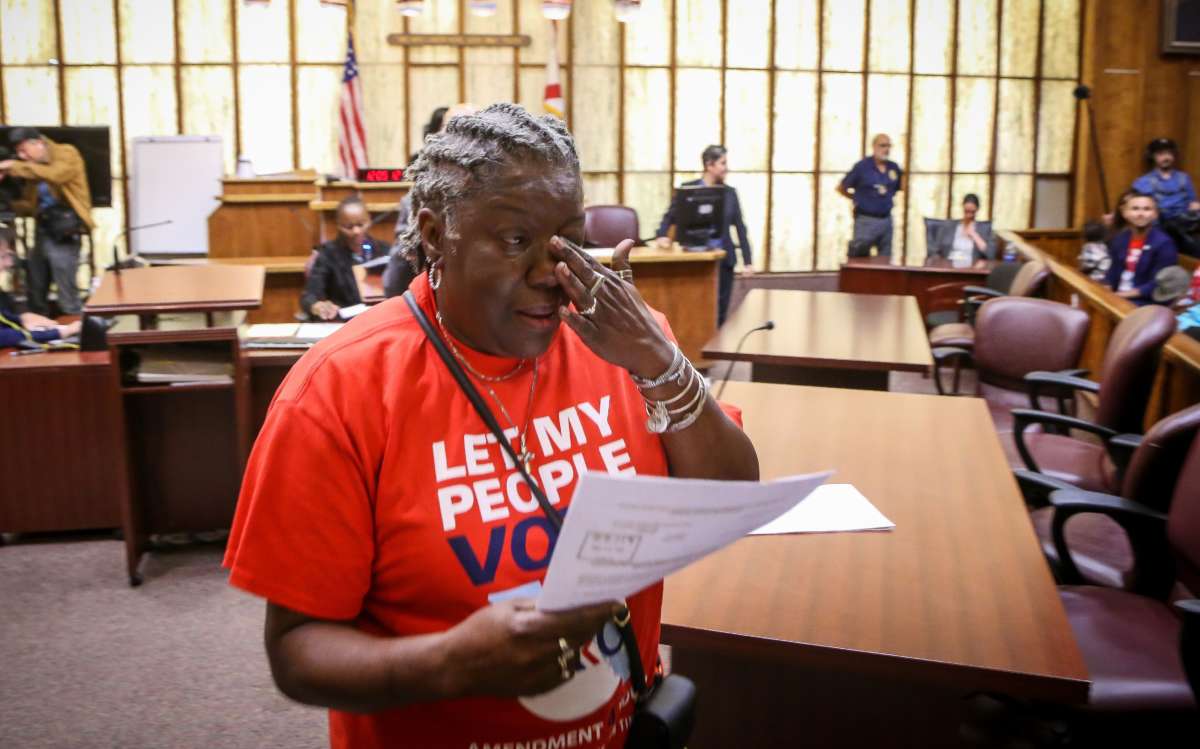
In a great win for democracy on Wednesday, a federal appeals court delivered a major blow to the efforts of politicians in Florida to thwart the historic Amendment 4.
Florida used to (and the operative phrase is “used to”) permanently disenfranchise all persons with felony convictions, a policy rooted in racism. It didn’t matter what you did, how old you were when you did it, or how long ago it happened. If you had a felony conviction, you were barred for voting for life unless the government decided to specifically pardon you, which for the most part didn’t happen.
Amendment 4 changed all that. In November 2018, Floridians from all walks of life came together and decided to end Florida’s policy of permanent disenfranchisement by changing the Florida Constitution. Sixty-five percent of Floridians voted for the amendment, which got more votes than any statewide candidate.
Then in a face-slap to the voting public, certain politicians passed and Gov. Ron DeSantis (R) signed a bill that required all people who were enfranchised by Amendment 4 to pay all of their legal fees and fines in order to get their right to vote back.
Florida is notorious for shifting the costs of its criminal justice system onto criminal defendants, and because people with past convictions have been prohibited from voting, they were unable to inject some real-world experience and expertise as to why this cost shifting was not just or sensible. And since Florida has no centralized system for tracking whether all of this money has been paid, the law made it next to impossible for impacted people to know how much they owe.
The Brennan Center sued in June 2019, along with the ACLU and NAACP Legal Defense Fund, arguing that the law violated the federal Constitution. A federal district court agreed, issuing a preliminary injunction forbidding Florida from prohibiting the registration of people with past convictions who couldn’t pay their legal fees and fines. The state of Florida, instead of taking the hint and finally doing what the people wanted, appealed.
Now, a unanimous three-judge panel of the 11th Circuit Court of Appeals has upheld the district court’s ruling, calling the law what it is: “the creation of a wealth classification that punishes those genuinely unable to pay fees, fines, and restitution more harshly than those able to pay — that is, it punishes more harshly solely on account of wealth — by withholding access to the ballot box.”
The court went on, concluding, “The long and short of it is that once a state provides an avenue to ending the punishment of disenfranchisement — as the voters of Florida plainly did — it must do so consonant with the principles of equal protection [].”
The governor’s office has said that he will appeal again, asking the full 11th Circuit to rehear the case. The longer the state drags out the litigation, the closer we get to the next election with a large number of people wrongly being kept from registering to vote.
Meanwhile, the case will continue to move forward in the district court towards a permanent solution. And the appeals court’s new ruling stands today as an important victory for voters — and democracy.
An urgent fundraising appeal: 8 Days to raise $46,000
Truthout is one of only a few platforms for justice-oriented, grassroots journalism. Today, we face an existential threat.
Due to Google’s launch of AI search, we’ve seen a drastic plunge in our site traffic and, as a result, our revenue. We lost 15 percent of our readership overnight. This was a readership we painstakingly built over decades, and it vanished because Google chose corporate greed over a healthy democracy.
We are fundraising right now to meet our basic operating expenses. If you can support Truthout with a one-time or monthly donation, you will make a significant impact on our work. Anything you can do makes a difference — we appreciate your support.