Truthout is an indispensable resource for activists, movement leaders and workers everywhere. Please make this work possible with a quick donation.
Consumers and scientists agree: Eggs from hens raised in cages are bad business.
“Cage-free” is much more than a trend — soon, it will be the industry standard. Demand from consumers and a slew of new laws has led the food industry to take significant strides to avoid being left behind by their competitors.
Between 2014 and 2016, nearly every major U.S. restaurant chain, retailer, food manufacturer, and food service company made a public commitment to their customers and stakeholders to phase out the use of caged-eggs in their supply chains. To date, over 400 companies have committed to sourcing 100 percent cage-free eggs by 2026, or earlier.
Egg suppliers are already shifting in response to the new demand. Since 2014, the proportion of egg-laying hens living in cage-free housing in the U.S. has grown from about 5 percent to more than 20 percent. This means that tens of millions of birds will no longer have to spend their entire lives confined to space the size of an iPad, which is like a human living in a filing cabinet.
Consumer demand and advocacy group pressure are not the only drivers of these industry shifts; state laws across the U.S. are also having an impact. In 2018, Californians voted to ban the production and sale of caged eggs in the state by 2022. In 2016, Massachusetts passed a similar law with 77.64 percent of the vote. And most recently, Oregon and Washington State passed legislation banning caged eggs by 2024. In states where caged eggs are banned, all eggs sold will be required to be cage-free, regardless of where they are produced.
In an era where nearly every issue is divisive and the American public can’t seem to find any areas of agreement, not abusing animals is a cause that the vast majority of us can get behind. With one study finding 77 percent of people concerned about the treatment of farm animals, especially those residing on factory farms, it’s time for the issue to move into our national political discourse.
The movement to abolish cages has expanded far past the U.S., though. Through the Open Wing Alliance, animal protection organizations all around the world have been winning new policies from major corporations. This global coalition has 70 animal protection nonprofits as members, and they’ve had great success in bringing progress to every corner of the world.
This alliance has been winning dozens of international cage-free policies from major corporations: Starbucks, Hilton, Marriott, Nestlé and dozens more. In addition to these global policies, there are more than 1,600 regional or country-specific policies being tracked in the Open Wing Alliance’s database, chickenwatch.org.
While making strong public commitments to improve the lives of animals in their supply chain is an important first step, the lives of those animals will only improve if companies are held accountable to do what they say they’ll do. To set the standard for years to come and ensure companies report on their progress as their deadlines approach, animal protection organizations are putting pressure on any company that has pledged to be 100 percent cage-free by this point but has since refused to disclose whether they’ve made any progress toward their goal at all.
Several companies have remained under the radar on reporting on their progress, including Omni Hotel & Resorts and Fogo de Chão. They have been deemed publicly as “Rotten Eggs” for keeping their customers in the dark while profiting off empty promises of higher welfare. Fortunately, other companies have helped to set a strong precedent in the industry by already fulfilling their cage-free promises. Shake Shack, Hormel Foods, Taco Bell and Papa Johns have all made good on their commitments.

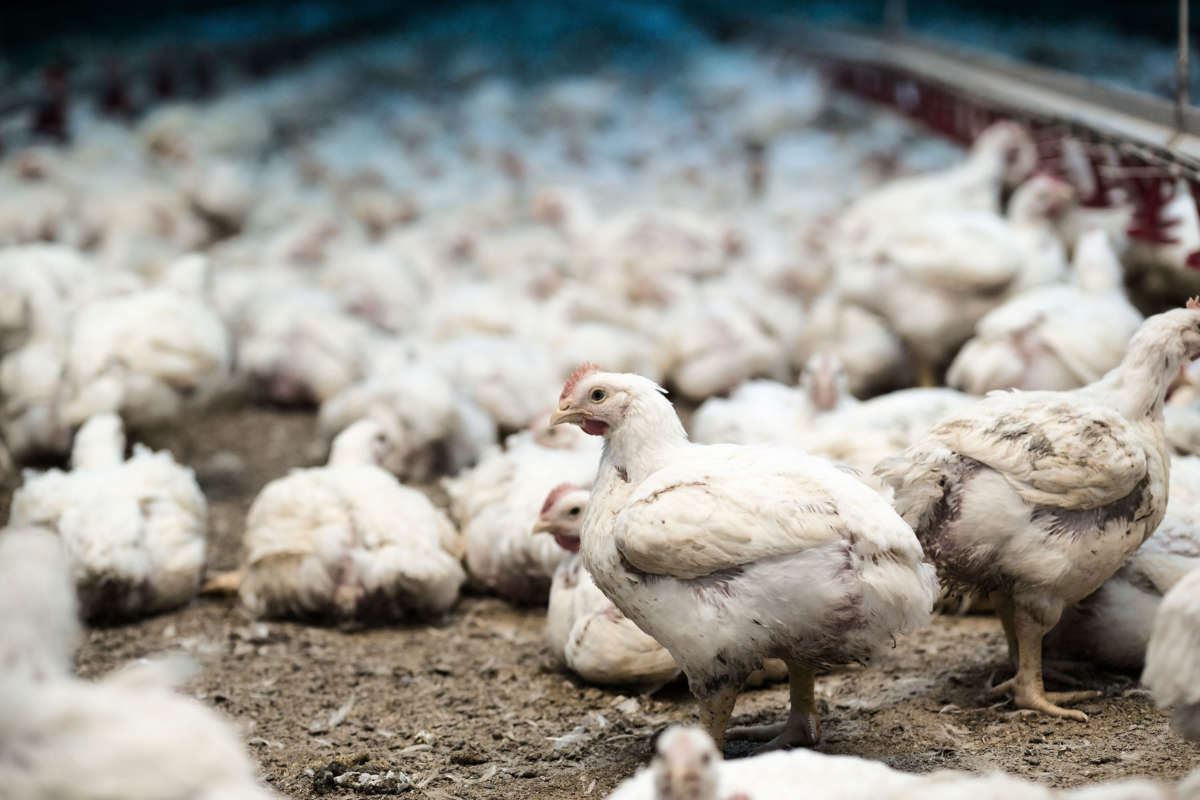
There’s inherent cruelty in the industrial chicken industry. By influencing the policies of those responsible through resources like the Fast Action Network and individually limiting our consumption of animal products, we can help move companies across the cage-free goal post and improve the livelihood of hundreds of millions of birds.
This article was produced by Earth | Food | Life, a project of the Independent Media Institute.
25 Years of Truthout: An important fundraising appeal
This September, Truthout is celebrating 25 years of publication. For over two decades, we have been a trusted source for fiercely independent journalism thanks to readers like you.
As we look to the next 25 years, we have launched a special fundraising campaign. Looking to a sustainable future for our publication, we have a fundraising goal of $84,000 in the next 7 days.
We are asking for your support at this juncture because we face greater threats than ever before in our organizational history. Trump and his MAGA allies are determined to control the information ecosystem, and movement-based organizations are subject to dangerous censorship and scrutiny.
If you can support Truthout with a one-time or monthly donation, you will make a significant impact on our work and our legacy. Anything you can do makes a difference!