Did you know that Truthout is a nonprofit and independently funded by readers like you? If you value what we do, please support our work with a donation.
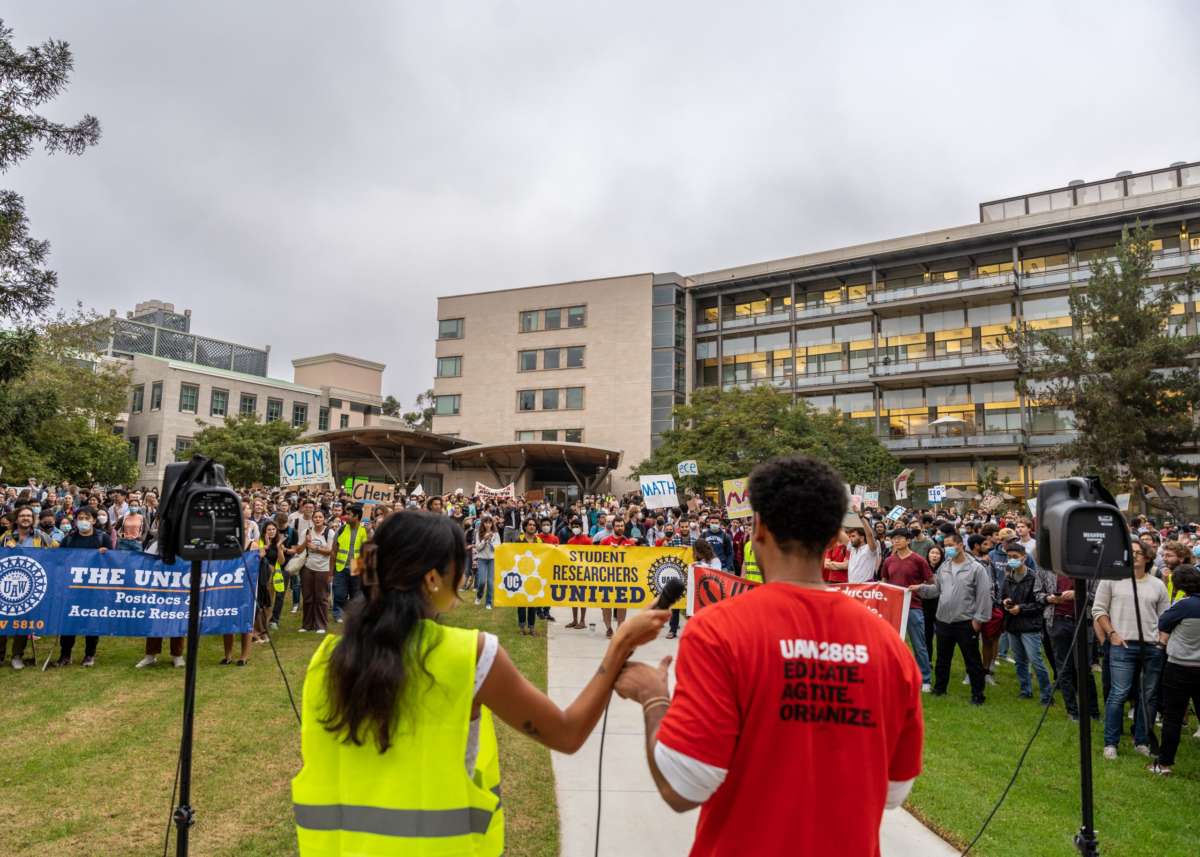
Approximately 48,000 academic workers across the University of California’s (UC) 10 campuses went on strike on Monday, marking the largest U.S. strike in 2022 and potentially the largest academic strike ever waged by higher education workers in the U.S.
Represented by several United Auto Workers (UAW) locals, graduate students, postdocs, teaching assistants, and other academic workers — altogether making up an indispensable but often overlooked workforce in academia — have walked off the job after authorizing a strike earlier this month with 98 percent of the vote among over 36,000 voting members.
The strike comes after negotiations between the unions and the university have broken down over months, particularly over pay. UC “left us no choice but to escalate,” one union leader said, as some academic workers have been stuck at the bargaining table for over a year.
Workers say they have been subject to years of financial abuse at the hands of the system, with some workers making $24,000 a year or less, according to union leaders. The workers are demanding a base pay of $54,000 a year for graduate workers and other provisions like improved child care benefits and free public transit passes.
This base wage would be slightly above a living wage for an individual with no children in California overall, though still less than a living wage in places like San Francisco, where one UC campus lies. As it is, the unions have found in a survey that 40 percent of graduate students spend more than half of their pay on rent, while 92 percent use more than 30 percent of their pay on rent; some workers report being forced to take on credit card debt just to survive.
The unions have accused UC of not bargaining in good faith and have filed dozens of unfair labor practice charges against the university, including for things like allegedly unilaterally changing transit benefits.
“We have been bargaining throughout the weekend and while important progress has been made, we are still far apart on many of the issues that will make UC a more equitable university: dignified compensation that addresses the crisis of affordable housing, access to transportation benefits so those who must commute can do so affordably and with a minimal carbon footprint,” and more, UAW 2865 President Rafael Jaime said in a statement. UAW 2865 represents 19,000 of the striking workers.
“We are hopeful that UC will cease its Unfair Labor Practices and bargain with us in good faith,” Jaime continued.
The unions have emphasized that they represent the backbone of the university — that, despite often low wages, the universities would not have the prestige or research output that they boast without the graduate student workers.
In negotiations, UC has countered with salary raises of 4 to 7 percent the first year — not enough to cover inflation increases, as of October — and 3 percent in subsequent years.
The university also contends that it provides campus housing below market value, though workers say that rent for campus housing can still amount to a significant chunk of worker pay; as UAW 2865 President Rafael Jaime told the Los Angeles Times, rent for a studio at UC Los Angeles is about $1,600 a month, or 80 percent of the average monthly pay of $2,000 for graduate students.
This is the second time in recent years that UC academic workers have expressed vast discontent with conditions; UC lecturers similarly contended that the university doesn’t sufficiently value them when lecturers voted to strike in late 2021. A strike of about 6,500 lecturers was narrowly averted as the workers won salary increases of about 30 percent over the next five years and pledges for better job security.
There were also a number of “wildcat” strikes at UC Santa Cruz and other UC campuses in recent years as graduate workers demanded better pay, ultimately winning compensation increases and the reinstatement of several dozen workers who were fired.
25 Years of Truthout: An important fundraising appeal
This September, Truthout is celebrating 25 years of publication. For over two decades, we have been a trusted source for fiercely independent journalism thanks to readers like you.
As we look to the next 25 years, we have launched a special fundraising campaign. Looking to a sustainable future for our publication, we have a fundraising goal of $63,000 in the next 4 days.
We are asking for your support at this juncture because we face greater threats than ever before in our organizational history. Trump and his MAGA allies are determined to control the information ecosystem, and movement-based organizations are subject to dangerous censorship and scrutiny.
If you can support Truthout with a one-time or monthly donation, you will make a significant impact on our work and our legacy. Anything you can do makes a difference!