Did you know that Truthout is a nonprofit and independently funded by readers like you? If you value what we do, please support our work with a donation.
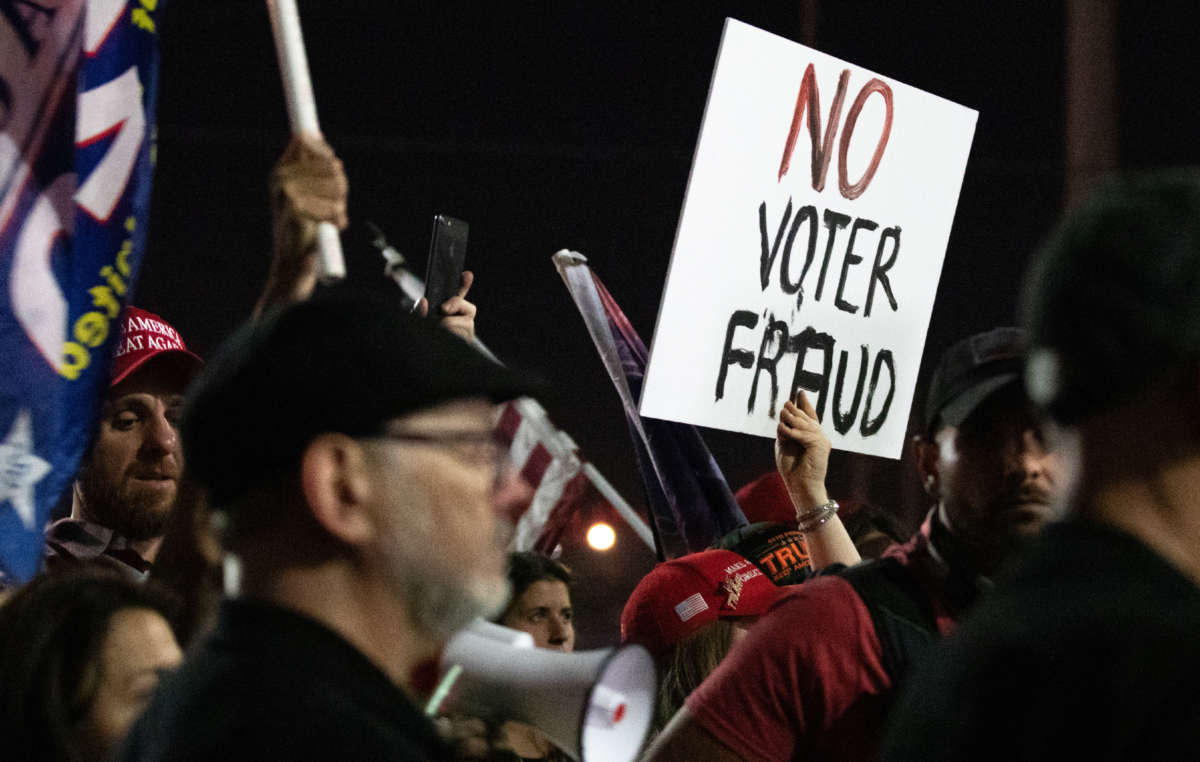
Across the country, Republicans have been behind a flurry of over 250 laws introduced to suppress voting after their candidate lost the presidential election. One Arizona lawmaker on Thursday had an answer for why the GOP is pushing these laws: “[Republicans] don’t mind putting security measures in that won’t let everybody vote — but everybody shouldn’t be voting.”
Democrats, GOP Rep. John Kavanagh of Arizona explained to CNN, want everyone to be able to vote and are “willing to risk fraud.” Republicans, especially since former President Donald Trump lost the election, are more concerned about voter fraud — which is statistically insignificant according to voting officials — so they’re willing to suppress votes, Kavanagh said.
“Not everybody wants to vote, and if somebody is uninterested in voting, that probably means that they’re totally uninformed on the issues,” Kavanagh told CNN. “Quantity is important, but we have to look at the quality of votes, as well.”
CNN does not specify what Kavanagh means by the “quality” of votes, though it’s possible that Kavanagh may be referring to the party that the vote is for. After all, when asked to explain why the Republican Party wants to gut the Voting Rights Act last week, the attorney for the Arizona Republicans told the U.S. Supreme Court that allowing more people to vote “puts us at a competitive disadvantage relative to Democrats.”
Though it’s been clear to observers that the Republicans are trying to suppress votes — especially the votes of Black, Indigenous, and other people of color — with bills restricting voting access and challenging the Voting Rights Act, it’s rare that a lawmaker has said it as directly as Kavanagh has.
Kavanagh, it should be noted, is wrong in his sweeping statement about why people don’t vote. Some don’t vote in presidential elections in the spirit of protest; others may choose not to vote even if they are well informed on the issues because they don’t think their single vote makes a difference; and still others don’t vote not because they don’t want to, but because they cannot, owing to their inability to overcome the many barriers that have been created — largely with the underlying intention of suppressing their votes — such as those pushed by Republicans in many states where they control the government.
In Arizona alone, Republicans are targeting voting rights with two dozen measures. Several of them, CNN reports, impose new restrictions on voting by mail and limit mail-in ballots to a very narrow window.
Republican Arizona State Sen. Michelle Ugenti-Rita claims that the reason she sponsored the law shrinking the early voting period is that she wants to ensure that mail-in ballots aren’t sent to the wrong people. The bill would automatically exclude people from receiving mail-in ballots if they haven’t voted in the last four elections and they don’t respond to a mailing from the state. “Allowing voters to sign up in perpetuity does increase the opportunity for things to go wrong,” Ugenti-Rita said.
The issue of ballots being sent to the wrong place is a vanishingly small issue since election officials can recognize if people have double voted. Since 2010, the Arizona attorney general’s office has only successfully prosecuted 30 counts of voter fraud.
Nevertheless, the Brennan Center’s February analysis of voter suppression bills across the country found that Arizona led the country in proposed bills that make it harder to vote — though, with bills filed since then, Georgia may be giving Arizona a run for its money. Georgia and Arizona are particular targets for Republicans since they surprisingly voted blue on Election Day last November, leading to the GOP losing control of Congress and the White House.
Many of the voter suppression efforts being waged by Republicans are almost explicitly racist. A bill that passed Georgia’s Senate last week, for instance, ends no-excuse absentee ballots in the state after Black voters turned out in droves with mail-in ballots. The state’s House has also passed legislation that severely limits early voting in the state on Sundays, which are typically huge days for Black voting due to church-led “souls to the polls” events.
Republicans are also waging challenges, as referenced earlier, to the Voting Rights Act in the Supreme Court. The Voting Rights Act was originally established to ensure that racial discrimination didn’t prevent Black and other nonwhite people from voting, but Republicans are going to bat to gut what’s left of the law.
Congressional Democrats have been fighting back against these efforts with H.R.1, the For the People Act. The House passed the act last week, and if it became law, would increase transparency in campaign financing, attempt to prevent gerrymandering and establish a nationwide automatic voter registration system. No Republicans voted for the bill.
25 Years of Truthout: An important fundraising appeal
This September, Truthout is celebrating 25 years of publication. For over two decades, we have been a trusted source for fiercely independent journalism thanks to readers like you.
As we look to the next 25 years, we have launched a special fundraising campaign. Looking to a sustainable future for our publication, we have a fundraising goal of $71,000 in the next 5 days.
We are asking for your support at this juncture because we face greater threats than ever before in our organizational history. Trump and his MAGA allies are determined to control the information ecosystem, and movement-based organizations are subject to dangerous censorship and scrutiny.
If you can support Truthout with a one-time or monthly donation, you will make a significant impact on our work and our legacy. Anything you can do makes a difference!