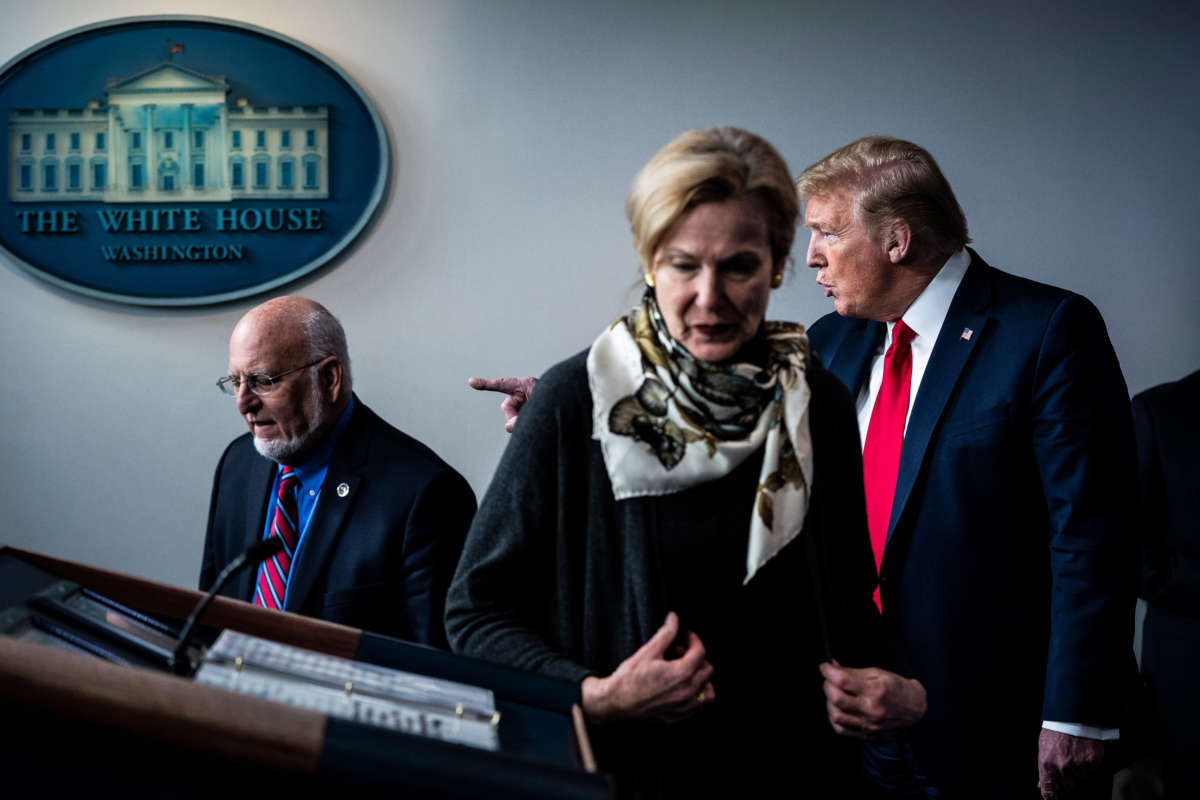
President Donald Trump has privately expressed doubts about the coronavirus death toll in the United States, telling aides he believes the number is too high and overcounted.
Earlier this month, Axios reported that Trump had been mulling over the numbers, which he’s suggested are inflated. A number of aides surrounding the president have expressed agreement with him.
“The numbers have been revised up to include presumptive cases — meaning deaths that are believed to be related to COVID but not known for sure…. So he’s expressed the need to properly convey that to American people so they’re not startled by why numbers ticked up,” one official told the news site.
Private concerns and complaints about statistics are one thing — but according to a report from The Daily Beast, officials who are aligned with Trump’s view have been pushing the Centers for Disease Control and Prevention (CDC) to revise how it calculates the number who have died, in order to show a lower count.
As of Wednesday morning, more than 83,000 deaths from coronavirus have been reported within the United States.
Some of those pressuring the CDC include members of the White House coronavirus task force, including Deborah Birx, who serves as the response coordinator for the team. Birx is not presently part of the CDC (before working with the task force, she was part of the State Department) but has worked within the agency in the past.
Many who are close to Trump have expressed doubts about the ways deaths are being calculated, and some have pushed demonstrably false narratives about which deaths are attributed to coronavirus.
“When you attribute a death to the coronavirus today, what that means is that the guy had the coronavirus and died,” Art Laffer, a conservative economist who often advises the president, said. “It doesn’t matter if he got hit by a car and died, and he would still be categorized as a coronavirus death.”
Bob Anderson, chief of the mortality statistics branch at the CDC, pushed back on Laffer’s comments, saying that physicians, when trying to document a cause of death in a patient, are asked: “Did the patient die as a result of this illness?”
“It doesn’t say ‘Did this patient die?'” Anderson told The Daily Beast.
Officials at the CDC are reportedly pushing back against the efforts to change its calculations.
“The system can always get better,” one unnamed official at that agency told the publication. “But if we’ve learned anything it’s that we’re seeing some of these individuals who have died of the virus slip through the cracks. It’s not that we’re overcounting.”
Anderson said the coronavirus death count is the opposite of exaggerated.
“I don’t worry about this overreporting issue. We’re almost certainly underestimating the number of deaths,” he said.
Indeed, his view is shared by one of the most trusted individuals in the U.S. today on COVID-19, Anthony Fauci, who is also part of the coronavirus task force. On Tuesday, while speaking in front of a Senate committee on the issue of the disease, Fauci explained why the count was probably a conservative estimate.
“Most of us feel that the number of deaths are likely higher than that number because given the situation particularly in New York City, when they were really strapped with a very serious challenge to their health care system, that there may have been people who died at home who were not counted as COVID because they never really got to the hospital,” he explained.
Early counts of coronavirus may have been missed entirely. Data from a number of studies have demonstrated that thousands of “excess deaths” were discovered in the U.S. in March and April, that haven’t yet been attributed to coronavirus. The sheer volume of deaths that exceed the mortality statistics normally seen around this time of year in the country suggests that many of these deaths were likely due to COVID-19.
Join us in defending the truth before it’s too late
The future of independent journalism is uncertain, and the consequences of losing it are too grave to ignore. To ensure Truthout remains safe, strong, and free, we need to raise $48,000 in the next 8 days. Every dollar raised goes directly toward the costs of producing news you can trust.
Please give what you can — because by supporting us with a tax-deductible donation, you’re not just preserving a source of news, you’re helping to safeguard what’s left of our democracy.