Truthout is an indispensable resource for activists, movement leaders and workers everywhere. Please make this work possible with a quick donation.
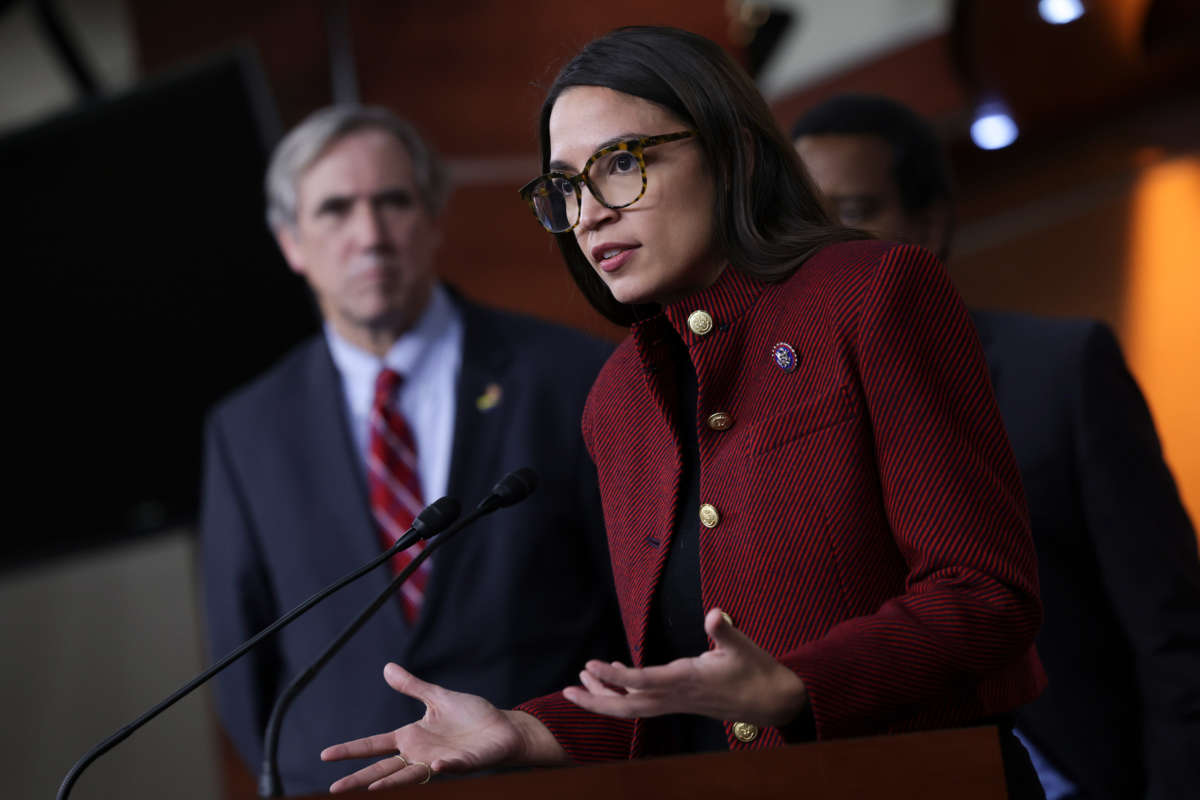
Rep. Alexandria Ocasio-Cortez (D-New York) pushed to pass a stock trading ban for lawmakers last week, warning that if such legislation isn’t passed, bad faith actors will take advantage of public mistrust in Congress over members’ ability to trade stocks in order to erode democracy.
In a press conference calling for Congress to pass a ban on stock trading, Ocasio-Cortez said that the issue “isn’t just about actual impropriety, but … about the perception of impropriety.” One of the many consequences of corruption and insider trading within Congress, she pointed out, is that it undermines the public’s trust in the nation’s top legislative body.
The nation is currently “tackling a crisis of faith in our institutions,” Ocasio-Cortez said. “And that exploitation of that crisis of faith is a direct threat to our democracy, as we have seen over the last 2 to 4 years…. because it is these perceptions that can be exploited to undermine our most sacred institutions.” There is a “very direct connection” between public distrust of Congress and the erosion of democracy, she went on.
On Thursday, Ocasio-Cortez spoke with Democrats in the House and the Senate calling for lawmakers to pass a stock trading ban. The press conference came directly after a House Administration Committee hearing examining the issue, which has bipartisan support in Congress.
“We have to be able to assure the American people … that they don’t have to worry about if they’re competing with their member of Congress’s stock portfolio in order to be heard,” Ocasio-Cortez concluded. “It’s a pretty simple concept.”
There are several proposals to ban stock trading; Ocasio-Cortez, Rep. Joe Neguse (D-Colorado) and Sen. Jeff Merkley (D-Oregon), among others, introduced a bipartisan bill called the Ban Conflicted Stock Trading Act last year, which would ban lawmakers and their spouses from trading individual stocks while in office. The bill would give lawmakers the option to sell the stocks before taking office or move them into a blind trust, similar to Senators Jon Ossoff (D-Georgia) and Mark Kelly’s (D-Arizona) bill.
Also before Congress is Sen. Elizabeth Warren (D-Massachusetts) and Rep. Pramila Jayapal’s (D-Washington) bipartisan bill that would force members and their spouses to divest entirely from stocks other than widely held investment funds, which they would only be allowed to trade if there were no conflicts of interest. Government watchdog group Citizens for Ethics and Responsibility in Washington says that full divestment from individual stocks is crucial to the success of the ban.
“Don’t forget that a very small percentage of the American people actually own stocks. This is a privilege of the wealthiest to even own stock,” Jayapal said. “Let’s be clear that there is something very wrong when people who do own stock look at the trades of members of Congress in order to determine whether or not they should buy a stock. There is a direct correlation.”
Members of Congress as a whole frequently beat the market in stock trading — and the trades they make are often valued in the millions. Last year, members of Congress bought and sold nearly $290 million in stocks.
Democrats are working on consensus legislation to bring to a vote, but there isn’t yet a timeline for when a bill could be passed. On Thursday, Merkley said that Democratic lawmakers are “essentially unanimous” in their support for a ban. Although some Republicans have voiced their opposition, a handful of Republicans have cosponsored or helped to introduce multiple bills, indicating that there could be enough support among the caucus to overcome a 60-vote filibuster in the Senate.
Banning stock trading within Congress is enormously popular with voters. Poll after poll has found that voters across the political spectrum are in favor of the idea; a January survey from Data for Progress found that, when presented with arguments for and against the issue, 74 percent of people supported a ban.
An important fundraising appeal: 7 Days to raise $44,000
Donations are down for Truthout at a time when media is under immense pressure. Google’s AI search has driven our traffic down by 15 percent, Trump is arresting journalists, and many independent media organizations face heartbreaking cutbacks and closures.
At the same time, movement media is vital in the fight against Trump’s authoritarian reign. Our mandate to tell the truth, share strategies for resistance, and speak against fascism is ever more urgent in this deluge of political censorship and misinformation. Yet, we are struggling to meet our publishing costs when our work is so urgently needed.
We are fundraising right now for those basic operating expenses — we need $44,000 in the next 7 days. If you can support Truthout with a one-time or monthly donation, you will make a significant impact on our work. Anything you can do makes a difference.